Latest Posts

More hipsters for future!

When we talk about digitalisation today, we are talking about technology first and foremost. There is a lot of talk about artificial intelligence. Before that it was Blockchain. The 3-D printer’s been around a while. But algorithms that are actually found everywhere in the digital world are currently repositioning themselves. Nobody talks about hipsters!

Hipsters in particular, like the hippies of yore, are the drivers of change. Totally nonconformist they show us how it works differently. They take us into the future. They try things out, take no account of existing structures. No matter if they have a beard or not – and yes, they have reinvented coffee (you know, a little more sour, more aromatic, handbrew and not quite so hot, but guaranteed by sustainable plantations). And that’s exactly why we need them! To bring digital “solutions” into our society that fit the new structures made possible by digitalization. Because the hipsters turn technology into solutions. Applications that we humans need (or sometimes don’t need), but which are in any case tangible – they are the hippies of the modern age, only different, more digital, driven by slightly different values, but in essence set out with the desire to provide more and new quality of life.

A beer to the digital future

Thus, social media and new logistics concepts become craft beer breweries. That’s right! Without the digital distribution possibilities and without the logistical bypass of the wholesalers, who would never have listed them, many beer start-ups would not exist. And by the way, not without the use of artificial intelligence and algorithms with which Mr. Hipster’s colleagues optimize all processes of production, logistics and international exchange, thus achieving cost efficiency like the industry once did with huge plants – and not just a small brewing kettle in the backyard. And at the same time with higher quality and an international network of craft beer friends – Crowd Beering, so to speak.

Yes, dear readers, this is about digitalization, not beer. But good beer is possible again thanks to good digitalisation. And it is spreading that we will soon have a 20% share of the international market in major beer markets. Five years ago, this did not even exist. And this is exactly what we have to learn: solutions, not technology, will help us move forward in society and in the quality of life. And that is what the hipsters are showing us. Because they don’t accept anything that already exists, because they have nonconformism as their highest maxim in life and because they try it out. They play with digitalization. And if it produces good beer, great!

By the way, they have already made the same game with coffee. And with burgers. In most cities today there are burger maps. Maps for the highly enjoyable burger consumption, nothing more with standard plate plus cheese. Here too, the quality goes at the price with the ingredients and the familiarity, only in the digital environment.

Hipsters can also “new cities” and “new social behaviours”!

By the way, this is how they think of new cities. Well, they start with villages. Co-villages. Or co-living. They’re trying out new ways of living together, revolutionizing the culture of our society. Everything is only possible with digital structures in the background. In Copenhagen there are now large residential complexes in which people are brought together to form an optimal neighbourhood thanks to artificial intelligence. The idea is to create a functioning neighborhood in cities. This is hardly possible anymore, since cities are not built for people but for cars. And now for people again. Because hipsters get on their hind legs and say: I don’t want it like that anymore. Now I want it different. Because it works. And because it’s easy to do.

The effect in these new neighborhoods will not only be that it will exist again at all. There will be a better quality of life for everyone. People will understand each other better, take care of each other again, help each other, have interest in each other, know each other. Crime rates will fall, parcels will be accepted without any problems and when there is no more chicken broth in the house, you can ask your neighbour. Sure, there is “still”. But especially in cities, it’s becoming increasingly rare. That’s why the hipsters are rethinking it. And the villages, by the way. Because many hipsters also ask themselves the fundamental question: why should I obey the studies of the past and, as stated there, want to live in the city? I don’t have to. It is also possible (also, not always and everywhere) in the country. So go and try something new. Thanks to digitalisation this is possible.

“No respect” is a good solution.

So our society is changing front and back because hipsters are trying out all kinds of things in everyday life. They have no respect for technology. It either benefits them or they throw it away. They are also not technology addicts, not even addicted to social media. They have often recognized for themselves when it is used and when it is not.

We “normalos” are way behind, by the way. Above all, because we don’t experiment so outrageously openly with all the technology. We still listen up when people talk about artificial intelligence, knowing that it doesn’t really exist yet. We think we need to understand blockchain instead of just being able to better regulate the growth of hops for our craft beer. We are not yet thinking in solutions. But we should.

From hipster to gentlewoman and -men

But okay: it’s not just the hipster alone. Nonconformism is a great thing for change, but at some point new structures will have to be created that also include less experimental people. And that brings us to the gentlewomen and men. They are building new structures. On what the hipsters have previously destroyed and redefined. By the way, and that’s why we call this category of people Gentlewomen and -men, please in a humane way that is marked by high ethics and covers the broadest possible social spectrum. By the way, many hipsters become gentlemen and men. This was also the case with the hippies. Many have been accused of having thrown their convictions overboard. In doing so, they have only developed as human beings and have recognised for themselves that a society also needs forms and that all people must be included if possible. The hipster, if you want to blame them for something, thinks first of all of his own environment … but on the other hand this is important for the uncompromising and fast implementation of new ideas.

But anyway: first of all we should listen more to the hipsters and follow their esprit in terms of “just doing digital stuff” with many examples. Let’s stop having respect for digital and new technology. Let’s just play with it. Like hipsters (or like kids, if you don’t want to be a hipster). And then we use our potential to develop new social excellence and become gentlewomen and men and go through with it. In this way we have the chance to build a society that is not only shaped by technology and economic influences, but that is also a society for a better quality of life. And that would be great: if digitization as a term would no longer stand for the declared technological madness, but for quality of life. Then we would all have much more fun and look positively into the future.

The non-conformist podcast – for hipsters and gentlewomen and men!

And if you want to “hear” something about this topic (only in German), I recommend the wonderful podcast by Helena Stelzer and Lotti Cobler: Springender Punkt, of the WBS Academy. These two talked to me about the topic in a very entertaining way. I can only recommend it!

Zum Springenden Punkt – von Helena Stelzer und Lotti Cobler / WBS Akademie

You can go directly to the podcast on all relevant platforms. Hier exemplarisch der Link zu Spotify!

Requests to Max please send directly to welcome@maxthinius.de

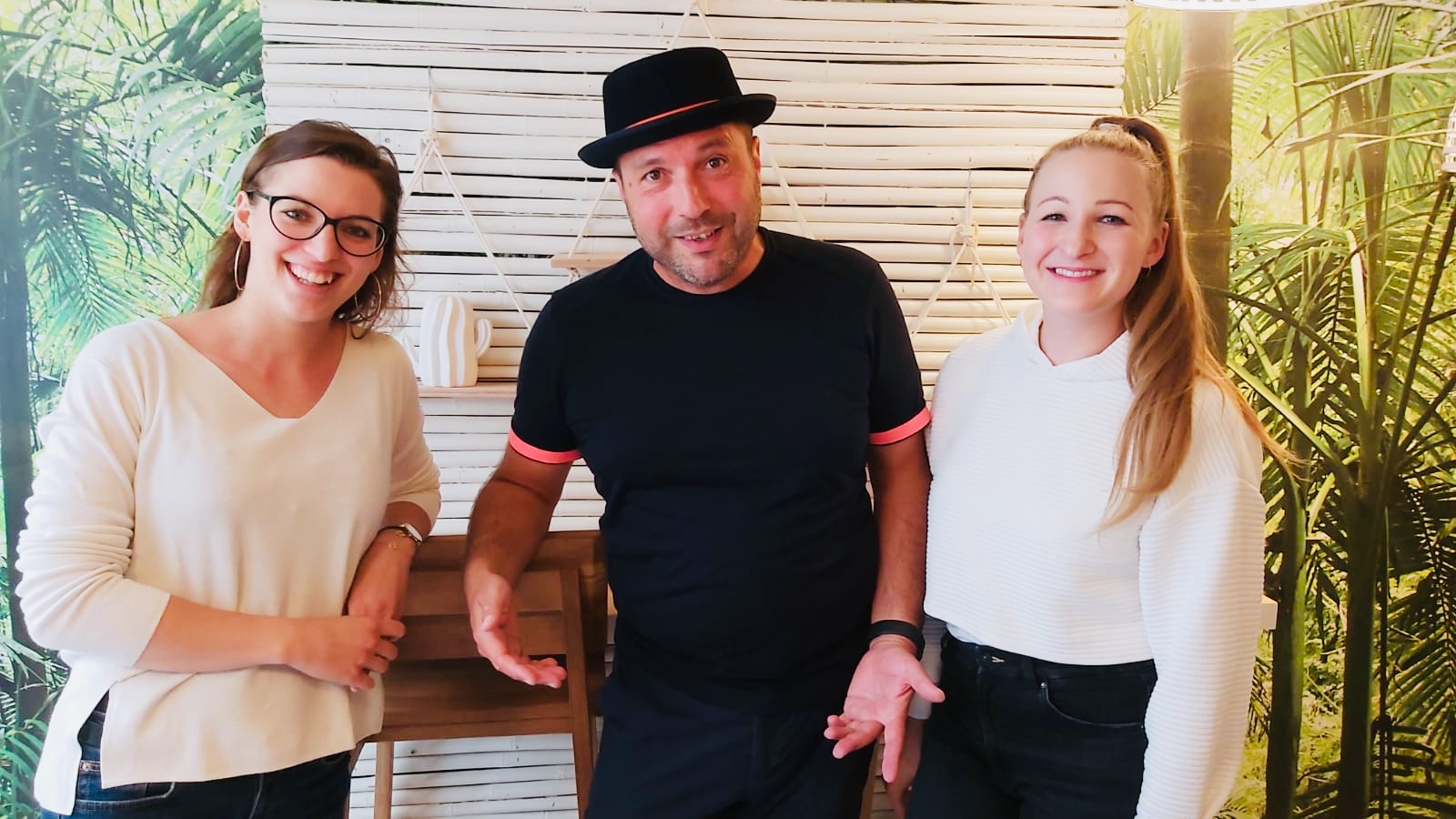
Helena Stelzer, Max Thinius, Lotti Cobler – Podcast „Springender Punkt„ der WBS Akademie

How we will learn and work in the future – my son and I.

Everyone should have the right to have their own algorithm!

How could and should we actually learn? Today and in the future! And how to work? What does NewWork mean and how could our life as a whole change? My son Emilio and I have done an experiment together with the educational podcast TabulaRasa. (Links to the podcast – at the bottom please)

We talked about education. But not only from my perspective, but also from my son’s perspective. Who’s in the middle of it. At the time of the podcast he was 17 and in 12th grade at the Evangelische Schule Berlin Zentrum ESCZB in Berlin. Once built by the great education revolutionary Margret Rasfeld, today still a great school. Nevertheless Emilio has a clear view of the whole school system.

Who could say more about education today than a student

He feels, like many other students, that this system is no longer right at the back and front. That there is learning for something that is no longer needed in reality. That teaching methods are being used that are outdated. That material and skills are taught that are based on the needs of the industrial age but have nothing, nothing at all, to do with the requirements of a digital society.

In addition, and this is my part of the story, there will be a lot more changes in the area of technology, social values and required skills, in addition to the changes in society that are already apparent today – and a school system that is already far off the mark. And then the school system of today will hardly make sense anymore.

Children today are “kept” in school far below their talents.

Children today are already “caught” in school. They do not learn to live, but, apart from some basic skills, they learn such incredible nonsense that they will never need it again in their lives. Now in the upper school this becomes particularly clear with Emilio: there it is no longer at all about “learning” competences or contents and their branching out in the head. It is above all about getting a good grade in the Abitur. And that’s why, above all, exercises are held that are relevant to the exam. But only that! So children are trained to have material in their heads that they have to be able to recall once in their lives, namely for the Abitur, in order to get a good grade. In order to get a good grade…

Do we still need a high school diploma in the future?

Honestly: who needs a high school diploma? And for what? In the future, we may not even know a school-leaving certificate as we do today, since we learn all our lives anyway. In the future we will work in projects, in an employee’s market (there will be more work than employees) and between the projects, in coordination with the employer, we will further qualify ourselves for the next project. Because knowledge and the application of knowledge will change.

In the past we have gained knowledge and experience. Today, it is much more important to have basic skills to apply knowledge. Knowledge and experience are much better given by machines. This is already the case in many cases today, and it will increase many times over in the coming years. And we are still working on Humboldt’s basic ideas for an education system?

It is not only about the education system – the whole social system must be adapted.

Yes, we need to change more than the school system. Also the university system, but above all the lifelong education system. We have to get fit again and again. To do this, we will have technological support in a completely new form. We must allow that to happen. We have to recognize where machines can make a valuable contribution to our everyday lives and where we can let them out better, in terms of social ethics. We simply need different skills and a different educational landscape.

Everyone should have the right to their own personal algorithm!

Just as we need our own algorithms! Algorithms that belong to ourselves. Not the big platforms. Just imagine, you own a personal algorithm that has been with you since birth and can advise you … because it knows you. You go with it to a shopping platform. Today you have an algorithm of the provider, who wants to sell you something in any case, tomorrow hopefully your own algorithm, which tells you: “Hey Max, honestly, you’re tired and just want to buy yourself happy – better leave it! We would get honest answers. That would be something.

Only with our own algorithm we have the power to defend ourselves against the global platform algorithms. Because we need them today to keep track of things. How much more would help us to keep track of things ourselves! With our own ideas.

Above all, however, we could also experience individual educational content with our own algorithm. We no longer need a largely equal education, as in industrialization, so that as many people as possible can keep the industrial wheel turning in the same way. Today, we need the most individual forms of talent possible and to solve the diverse and ever new tasks that come our way in the digital world together with others in ever new constellations.

TabulaRasa – The Podcast!

We have to rethink not only education – but our whole life. And this is exactly what the podcast Emilio and I recorded with TabulaRasa is about. First me – then Emilio. First the fundamental basis, then what is already wrong today.

Many thanks to Jenni and Felix from TabulaRasa for the great realisation!

You can easily find the podcast on the web if you search for “TabulaRasa Max and Emilio Thinius” or via one of the following links

Direct contact to Max is via welcome@maxthinius.de

Machines to power!

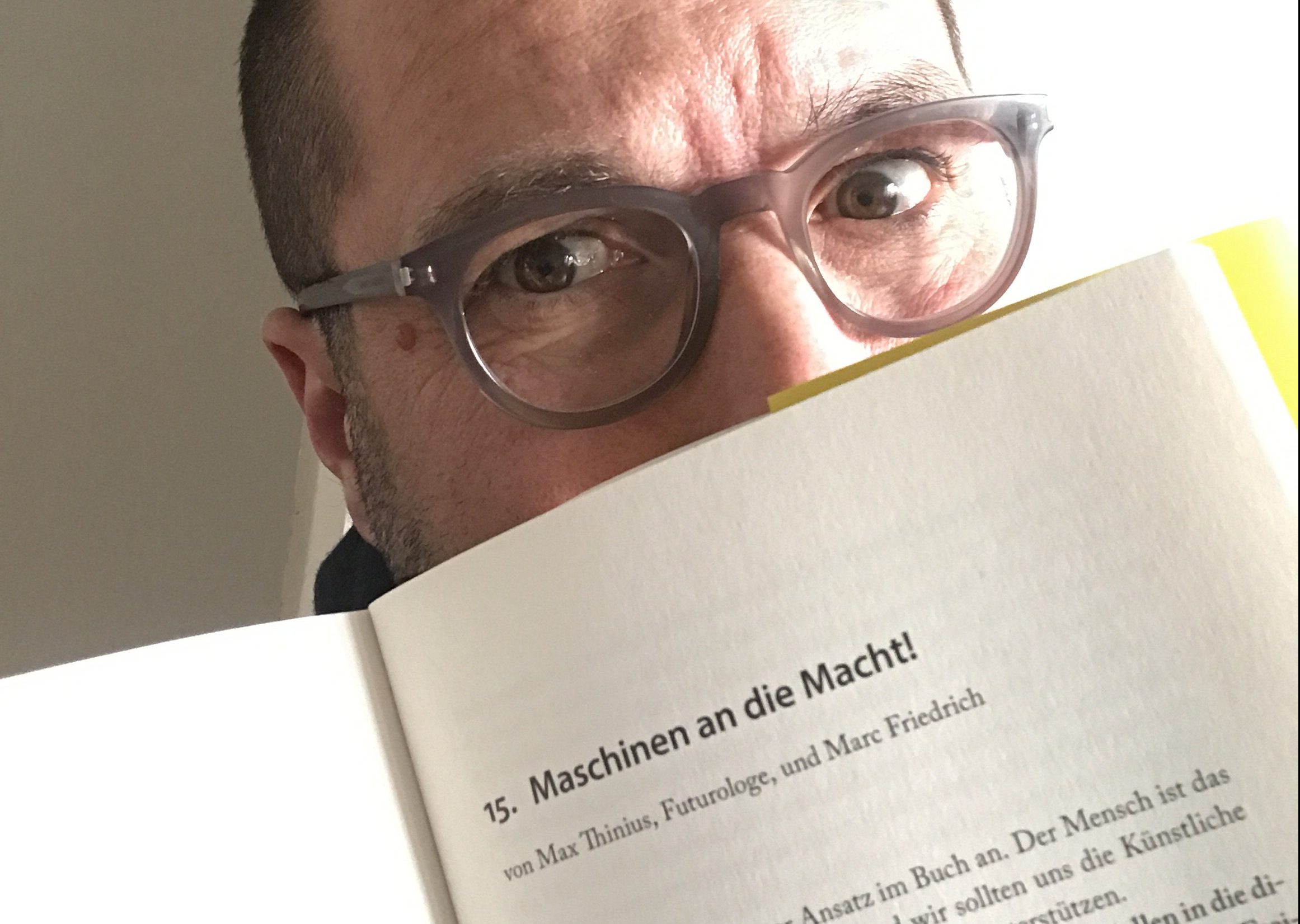
For my dear colleagues Friedrich & Weik, I have written an important chapter in their new bestseller as a guest author. – and made a lecture out of it.

We live here on this planet for thousands of years and all of a sudden machines come, say they have artificial intelligence and take over! Is that so? Or are machines perhaps even necessary so that we humans can continue to live on this planet for thousands of years?

Can we even do without machines? The new complexity of the world. Can we still absorb it without support? We use algorithms from Facebook, Amazon, Google and others as a matter of course. But no one is asking themselves the question: shouldn’t we actually have a right to our own personal algorithm? An algorithm that advises us in everyday life? An algorithm that at least reads our intentions and can therefore advise us better than an algorithm that only wants to sell?

Should politicians perhaps be replaced by machines? Perhaps because they no longer have an overview of the complexity of legal texts and prefer to consult an artificial intelligence machine that compares all the legal texts in the world with a new law in a fraction of a second? A machine that can do without lobbyists – and if so, what about the algorithm?

The new engines can do much more than the steam engines of the past. Not only can they replace our physical work and create more precision, they can also do the mental work for us. This will change the way we deal with them dramatically. And the structure of our society, economy, even art and culture, right down to our view of the spiritual.

About 80% of our everyday life will change due to digitalization. These are 80% chances to improve our quality of life!

Max

How we in our society best deal with these new machines, why the elite is against them and how we get them on board and create new perspectives for people, cities, villages and what our everyday life will look like – you can either read about it in this fantastic book or live on stage directly from Max!

anfragen@maxthinius.de

The book is available as e-book everywhere, at Amazon and directly from the authors at: info@fw-vs.de – it costs 20€ (German only)

A day in the future

To be very specific: what does a day in the future look like? Seven or 15 years from now. From getting up, through the day, into bed. What does a person experience? Which technology will he use? What skills will he need? How will social, economic and political conditions change?

One cannot dive more concretely into the future: especially not in such a comparable way. Because everything is structured around a concrete daily routine, you can directly compare all new findings with your own everyday life and draw conclusions.

And to make it even easier, you can experience this lecture with different focal points. All of them are based on a fundamental scenario of social development.

Industry focus can be:

General everyday life, agriculture, automotive, education, finance, society, commerce in general (online, offline), real estate, consumer goods industry, food, ministries, fashion, NewWork, politics, regions, urban development, telecommunications, entrepreneurship, business in general, and more are possible.

Keynote / Show – 60 min

Requests to Max as speaker or moderator

anfragen@maxthinius.de

Via VoiceBox: +49 30 6130 90 41

welcome@maxthinius.de

Bestselling Book

Max Thinius – Futurologist, bestselling author, moderator, is considered one of Europe’s leading futurologists with a focus on society, sustainability, business and trade.

Why it was important to me to write the new book by Friedrich & Weik!

We need a positive view of the future – urgently!

You know what? It bothers me if we discuss all topics in the present only negatively today. Where have our positive goals gone? When I was growing up, we had goals like: to revolutionize society in a positive way, to reduce the East-West tensions, to bring about reunification, social equality … Today we focus our attention mainly on crises. There is the refugee crisis, there is the climate crisis, there is the economic crisis, there is the social crisis, the populist crisis. It’s not that none of this is there, but the focus is not on positive solutions, but on the problems.

So why don’t we talk about a social development and promotion programme to develop new perspectives (instead of refugee crisis), why not promote sustainable social and economic structures (instead of climate crisis), why not opportunities through digitisation instead of risks to economic crisis). We could even take a positive look at the issues for a change.

The more people deal positively with the future, the more positive it will become!

People need perspectives – positive ones! Otherwise they see no sense in developing themselves further and getting involved in new situations. On the contrary: people without perspective are dangerous! They only think of themselves and even in an aggressive tonality they grasp everything about themselves.

I have set myself the task of developing positive scenarios for the future. These are by no means dazzling unicorns. The future IS POSITIVE. And quite honestly, we can see that again and again from the developments of the last millennia. There are sometimes cuts, but thanks to digital technologies we can keep even these quite tolerable today.

I show people, companies, regions and organisations how they have to learn to think differently. Digitalisation works differently than industrialisation. It looks similar in some parts, but it is completely different. New models of living and working can be developed with it. The existing structures often stand in the way. Take the euro for example: at the beginning it was a beneficial achievement, but now it’s more of a hindrance as it encourages injustice between nations. And they resist. With digital currency and new forms of money market control using, for example, tokens (part of crypto currency), ideal systems could be created. But we do not have to go that far. This is a big step. Nevertheless, today, and in a very compatible way, we could use artificial intelligence to create intelligent control structures that could help our society in Europe and beyond to achieve a new quality of life quite quickly.

In the new bestseller, “The biggest crash of all times” written together with Marc Friedrich and Matthias Weik.

That’s why I quickly became enthusiastic about the book by Marc Friedrich & Matthias Weik “The biggest crash ever” as a guest author. And I am delighted that after only 4 days we have conquered the bestseller list in the non-fiction section of this SPIEGEL with 1st place.

The two guys show very precisely the problems of today’s world, with a focus on our direct environment, here in Europe. They show where it crunches and cracks and where systems are simply outdated. And: they offer solutions. Not only for your own asset protection, but also for social reorganisation. Important solutions that everyone should read once. It is worth thinking about them. And this is exactly what the two call for.

My part describes very clearly how we can also make “machines” part of the solution. We must stop thinking industrially and still assume that machines exist in the extended form of the steam engine. Machines are so much more today. And this is not a threat, but a unique opportunity to reposition the world, to define a new form of quality of life, to experience new definitions of ethics and social community. At the same time, we may as well get used to the fact that politics, finance and other elite positions can get by without people. But does that make them superfluous? Probably not. But maybe we humans can do something useful again for a change when we get rid of conventional power thinking. “Machines to power!”, a chapter on thinking the future differently.

Everywhere where there are books!

Here is the link to the page of Friedrich und Weik

Max live!

Max live and my scenarios and solutions for “The greatest future of all times” can be found at anfragen@maxthinius.de

The future is gentle!

Why gentleman and gentlewoman are so important for shaping our future.

The Gentleman & the Gentlewoman of today and their new competences to shape the future of the digital era in economy, society and politics.

A 90 minute experience after which you encounter the world, the future, the economy, politics and society with different eyes, different attitudes and different ideas.

It is perhaps the most entertaining way to understand the reorganization of the world: Ato & Max “The gentle Pack” explain how the digital cultural change not only changes our everyday life, work, economy and politics, but also how we humans have to rethink and develop new values in order to be able to use the opportunities of the new age in the interest of ourselves and society. The gentleman is at the centre of this – and yes, he goes hand in hand with the gentlewoman. They will be the ones who create new perspectives. To describe and live the educational systems, legislation and social structures in a new way. And everyone can become a gentleman or a gentlewoman!

Together with Ato C. Yankah jr, nephew of one of the greatest gentlemen of all time, former UN Secretary General Kofi Annan.


Ato & Max stand as “The gentle pack” for a world that is driven by excellence and global values. Using technology not la pour la, but in the interest of humanity. And they describe very concrete scenarios of the future and the values that will be needed in this new age. Every listener will be able to develop a clear perspective for his or her life or that of their company afterwards. The fact that Ato and Max use their own black-and-white humour in this process helps to create a good feeling and a strong understanding – or to put it another way: how many scientific lectures can you remember?

(90 Min entertaining Show)

Request to Max or TheGentlePack

anfragen@maxthinius.de

Via VoiceBox: +49 30 6130 90 41

welcome@maxthinius.de


Feared of digital money?

Most people in Germany love cash. 88%, to be exact, prefer to pay cash rather than by card. Only from amounts of 50€ upwards does the cashless willingness to pay increase. But will we still be able to pay with cash in the future? Or will we even need a digital currency (colloquially called crypto currency)?

Sweden has set itself the target of no longer accepting cash from the 2030s onwards. Digital money is not yet that, just the cashless form of today’s currency. Real digital money works completely differently. And here most people are still afraid today. At least worry or incomprehension.

Digital currency could offer new perspectives for fair global coexistence. Incidentally, it would not even have to be traceable, which is the biggest concern of cash fans.

The other way round: CAN there even be a future for the economy and society without digital money? In the interview with the Wirtschaftswerkstatt you will find a few thoughts that shed light on the various perspectives and opportunities.

Wer neue Ideen für die Zukunft sucht:

anfragen@maxthinius.de

Via VoiceMail +49 30 6130 90 42

Max Thinius is also known about the famous London Speaker Bureau